
A Re Culture™ Institutional Perspective

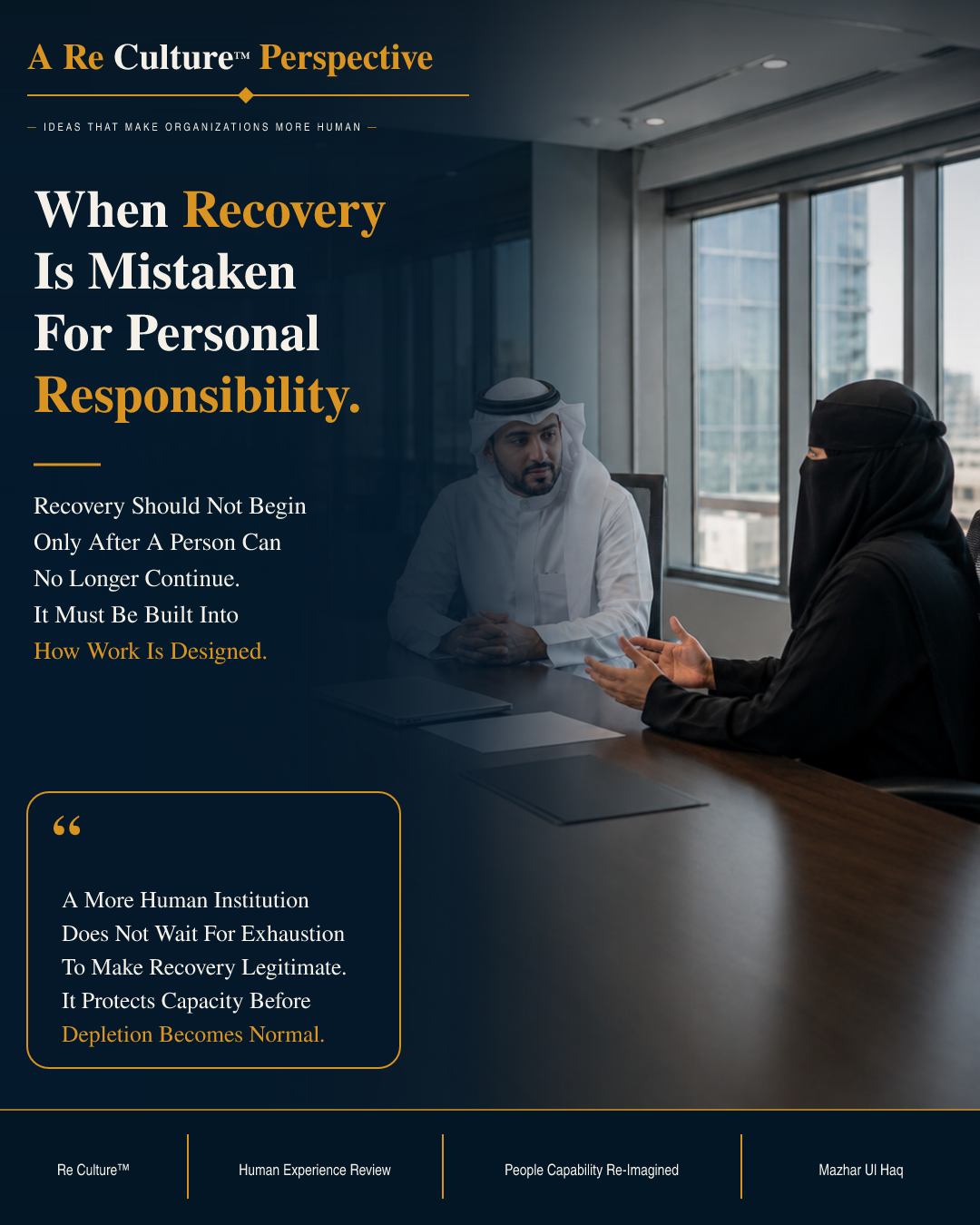
When Recovery Is Mistaken For Personal Responsibility

Work Mental Wellness · Module 06 · Visual 06 · Recovery · Work Design · Human Capacity
Work Mental Wellness Vision · Visual 06 · Module 06
Recovery Cannot Be Left To The Individual After Work Has Already Taken Too Much.
Published August 29, 2026 · Mazhar Ul Haq · Re Culture™
Publication Type: Founder-Conceived Institutional Interpretation · Evidence Review Open · Not Presented As Empirical Research
Re Culture™ Work Mental Wellness Visual 06 — When Recovery Is Mistaken For Personal Responsibility
A More Human Institution Does Not Wait For Exhaustion To Make Recovery Legitimate. It Protects Capacity Before Depletion Becomes Normal.
Visual Provenance: Interpretive AI-Assisted Editorial Composition. It Does Not Depict A Verified Real Person, Workplace, Event, Partnership Or Organizational Outcome. Conception And Final Approval: Mazhar Ul Haq.

Recovery Is Often Treated As Something That Begins After Work Has Already Taken Too Much. A Person Reaches The End Of A Difficult Period, Takes Leave, Uses A Wellbeing Resource, Or Is Encouraged To Rest. Recovery May Then Be Treated As A Personal Process To Complete Outside The Same Conditions That Depleted Them.

But Human Capacity Is Not Restored Simply Because Work Pauses. Recovery Depends On Psychological Detachment, Released Workload, Clear Priorities On Return, And Whether The System Stops Recreating The Same Demand. If Conditions Remain Unchanged, The Person Returns To The Source Of Depletion.

This Is Why Recovery Belongs Inside Work Design. It Is Shaped Before Anyone Requests Leave: In Staffing Levels, Pace, Role Clarity, Scheduling, Decision Rights, Workload Distribution, Handover Practices, Response Expectations, And Whether Leaders Treat Limits As Information Or Failure.

Counselling, Wellbeing Platforms, Leave, And Reflection Tools May Matter. Yet They Cannot Carry A Responsibility That Belongs To Leadership And Design. A Resource Offered After Strain Accumulates Does Not Remove The Conditions That Made Recovery Necessary.

When Recovery Is Individualized, The Burden Shifts Quietly. The Person Must Repair Sleep, Attention, Motivation, And Emotional Capacity On Their Own Time, Then Return Able To Continue. If They Cannot, Their Difficulty May Be Read As A Personal Resilience Gap Rather Than A System Signal.

More Human Institutions Make Recovery Legitimate Before Exhaustion. They Bound Intense Periods, Reduce Demand Afterwards, Allow Leave Without Hidden Access, Distribute Responsibility So Absence Does Not Become Guilt, Make Handover Possible, And Protect Breaks.

This Is Not An Argument For Removing Challenge. Meaningful Work Can Require Effort, Stretch, And Temporary Pressure. But Challenge Remains Sustainable Only When Supported, Time-Bounded, And Followed By Capacity Renewal. Continuous Demand Without Protected Restoration Is Depletion Waiting To Become Visible.

Leadership Must Examine Not Only Whether Recovery Options Exist, But Whether Work Permits Their Use Without Consequence. A Policy Can Authorize Rest While Workload Makes It Impossible. A Manager Can Encourage Disconnection While Modelling Permanent Availability. Leave Can Exist While Responsibility Continues Through The Phone.

Workplace Wellbeing Becomes Credible When Recovery Is Designed Into How Work Is Organized And Led. It Cannot Be Left To The Individual After Strain Has Accumulated.

A More Human Institution Does Not Wait For Exhaustion To Make Recovery Legitimate. It Protects Capacity Before Depletion Becomes Normal.

Reflective Question
What Conditions Must Change Before Recovery Can Become Possible Without Asking The Person To Carry Its Entire Burden?
| Re Culture™ Perspective |
Conception, Responsibility And Technology Assistance

Founder-Conceived, Human-Governed And AI-Assisted.

This Statement Records The Work’s Intellectual Origin, AI-Assisted Development, Human Responsibility, And Evidence Boundary. It Does Not Claim That Technology Played No Role In Its Development.

Conception And Intellectual Direction
Mazhar Ul Haq
Institutional Affiliation
Re Culture™
Editorial Development
Founder-Directed And AI-Assisted
Responsibility And Final Approval
Reviewed And Finally Approved By Mazhar Ul Haq
Classification And Evidence Boundary
Founder-Conceived Institutional Interpretation; Not Presented As Empirical Research Or A Validated Outcome Claim
Verification Status
Item-Level Verification Review Open; Correction Pathway Active
Published Record
Published August 29, 2026 · Permanent Institutional URL

Visual Details And Institutional Interpretation

Editorial Theme

Recovery As A Responsibility Of Work Design And Leadership Rather Than A Personal Repair Task Assigned After Depletion.

Human Experience Perspective

People Cannot Restore Sleep, Attention, Motivation, And Emotional Capacity If They Return To The Same Unchanged Source Of Demand.

Composition

The Locked English Composition Places The Institutional Thesis Beside A Human Subject In A Quiet Recovery Moment. The Approved Arabic Master Mirrors The Geometry With Native Right-To-Left Hierarchy And Tajawal.

Human Emotion

Fatigue, Contained Strain, Dignity, And The Need For Legitimate Restoration Are Held Without Turning Exhaustion Into Personal Failure.

Leadership Perspective

Leadership Must Examine Whether Staffing, Pace, Priorities, Handover, Decision Rights, And Response Expectations Permit Recovery Without Hidden Consequence.

Organizational Meaning

Leave And Wellbeing Resources Cannot Repair A System That Continues Recreating The Same Demand. Credibility Requires Recovery To Be Built Into The Organization Of Work.

Symbolism

The Human Subject Represents Capacity Asked To Restore Itself, While The Structured Editorial Field Marks The Institutional Conditions That Must Change Around The Person.

Lighting Philosophy

Warm Light Preserves Dignity And The Possibility Of Renewal, While Deep Navy Holds The Weight Of Demand That Has Not Yet Released Its Claim.

Constitutional Reflection

A More Human Institution Does Not Wait For Exhaustion To Make Recovery Legitimate. It Protects Capacity Before Depletion Becomes Normal.