
The Human Experience Review

Adaptability

Vol 1 | Human Experience Foundations
Issue 9 | Adaptability
The Human Capacity To Evolve Without Losing Identity
Published September 18, 2026 · Mazhar Ul Haq · Re Culture™
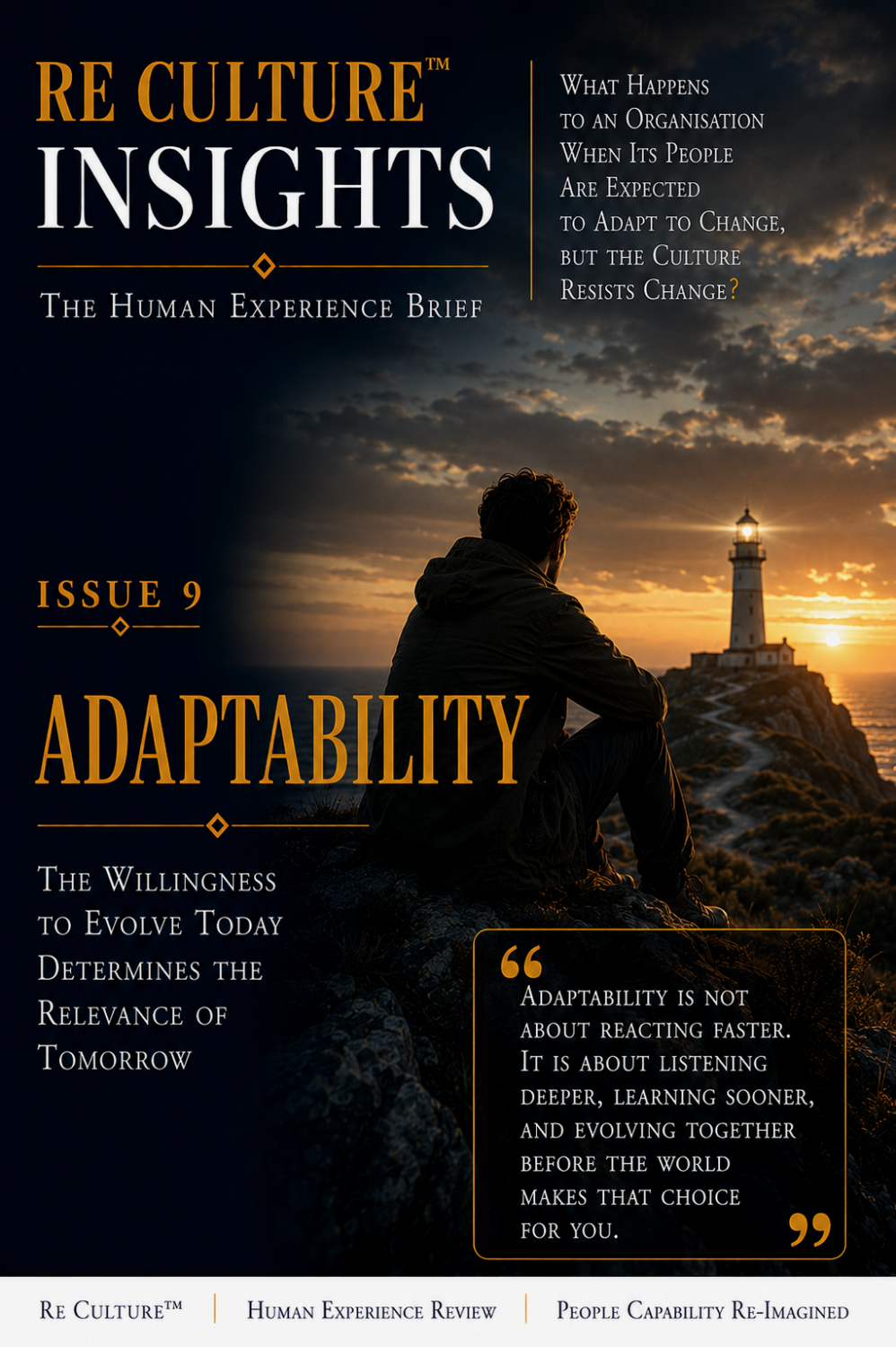
Adaptability — a seated human figure facing a lighthouse across a cinematic sea at sunset, representing the capacity to evolve without losing identity.
Adaptability Begins When People Can Move Towards What Is Becoming Necessary Without Losing Connection To Who They Are, What They Contribute, And Why Their Work Matters.
Visual Provenance: Interpretive AI-Assisted Editorial Composition. It Does Not Depict A Verified Real Person, Workplace, Event, Partnership Or Organizational Outcome. Conception And Final Approval: Mazhar Ul Haq.

What This Issue Is About. This Issue Examines Adaptability As A Human Capacity To Evolve Without Losing Identity. It Explores Why Change Becomes Difficult When Competence, Belonging, Or Meaning Feel Threatened, And Why Sustainable Adaptation Depends On Trust, Clarity, Learning, And The Ability To Distinguish Identity From Habit.

Organizations Often Describe Adaptability As The Ability To Respond Faster, Restructure Earlier, Or Move Ahead Of Everyone Else. Yet Speed Alone Doesn't Make An Organization Adaptable. An Organization Can Change Its Systems Repeatedly While Leaving Its People Disoriented, Just As It Can Preserve Familiar Practices Long After Those Practices Have Lost Their Purpose.

Real Adaptability Requires Discernment, It Requires An Organization To Understand What Carries Its Identity Forward, What Has Become Necessary To Release, And What Its People Must Be Given The Opportunity To Learn. Adaptability Is Therefore More Than A Strategic Capability. It Is A Human Capacity, It Develops Where People Can Question What No Longer Works, Acknowledge What They Do Not Yet Know, And Learn Without Feeling That Their Existing Contribution Has Been Devalued.

When Change Makes Competence Feel Obsolete, Belonging Feel Conditional, Or The Future Feel Imposed, Defensiveness Is Not An Unexpected Reaction. It Is Often A Human Attempt To Protect Meaning, Dignity, And Continuity. This Is Why A Transformation Can Be Strategically Convincing Yet Humanly Unprepared. People May Be Asked To Enter A Future They Had No Part In Understanding, To Adopt New Expectations Without Sufficient Clarity, Or To Leave Behind Familiar Ways Of Working Without Knowing What Will Remain Recognizable.

Leadership, In Such Moments, Is Not Merely The Management Of Timelines, Structures, And Outcomes. It Is The Responsibility To Help People Understand What Is Changing, Why It Matters, What Will Be Preserved, And How Their Place Within The Organization Can Continue To Hold Meaning. When Trust, Clarity, And Belonging Are Present, Adaptability Is Less Likely To Be Experienced As The Loss Of What Was Known. It Can Become A Shared Capacity To Move Forward Without Erasing The Human Experience That Made Progress Possible.

At Re Culture™ We Believe Adaptability Doesn't Require An Organization To Abandon Its Identity. It Requires The Maturity To Distinguish Identity From Habit. What Gives The Institution Meaning Should Be Protected. What Prevents Its People And Purpose From Evolving Should Remain Open To Reconsideration.

Reflective Question
Is Your Organization Asking People To Adapt Or Creating The Human Conditions That Make Adaptation Possible?
| Re Culture™ Perspective |
Conception, Responsibility And Technology Assistance

Founder-Conceived, Human-Governed And AI-Assisted.

This Statement Records The Work’s Intellectual Origin, AI-Assisted Development, Human Responsibility, And Evidence Boundary. It Does Not Claim That Technology Played No Role In Its Development.

Conception And Intellectual Direction
Mazhar Ul Haq
Institutional Affiliation
Re Culture™
Editorial Development
Founder-Directed And AI-Assisted
Responsibility And Final Approval
Reviewed And Finally Approved By Mazhar Ul Haq
Classification And Evidence Boundary
Founder-Conceived Institutional Interpretation; Not Presented As Empirical Research Or A Validated Outcome Claim
Verification Status
Item-Level Verification Review Open; Correction Pathway Active
Published Record
Published September 18, 2026 · Permanent Institutional URL

Visual Details And Institutional Interpretation

Editorial Theme

Adaptability As A Human Capacity To Evolve Without Losing Institutional Identity, Human Dignity, Or Meaning.

Human Experience Perspective

The Seated Figure Facing The Lighthouse Represents A Person Orienting Toward What Comes Next While Remaining Connected To Identity, Contribution, And Purpose.

Composition

The Full-Bleed Lighthouse Scene Places The Human Figure And Guiding Structure Within A Shared Horizon; The Arabic Master Mirrors The Spatial Architecture With Native Right-To-Left Hierarchy.

Human Emotion

Uncertainty, Attention, Readiness, And Quiet Resolve Express The Inner Work Of Moving Toward Change Without Erasing What Gives Experience Meaning.

Leadership Perspective

Leadership Must Clarify What Is Changing, Why It Matters, What Will Be Preserved, And How People Can Continue To Hold A Meaningful Place Within The Institution.

Organizational Meaning

Adaptability Becomes Sustainable When People Can Question What No Longer Works, Learn What Is Becoming Necessary, And Evolve Without Having Their Existing Contribution Devalued.

Symbolism

The Lighthouse Represents Direction Without Coercion; The Sea Represents Continuous Change; The Seated Figure Represents Discernment Before Movement; The Horizon Represents What Is Becoming Possible.

Lighting Philosophy

Gold Light Signals Possibility And Direction, While Deep Navy Preserves The Uncertainty And Seriousness Through Which Meaningful Adaptation Is Formed.

Constitutional Reflection

What Gives The Institution Meaning Should Be Protected. What Prevents Its People And Purpose From Evolving Should Remain Open To Reconsideration.