
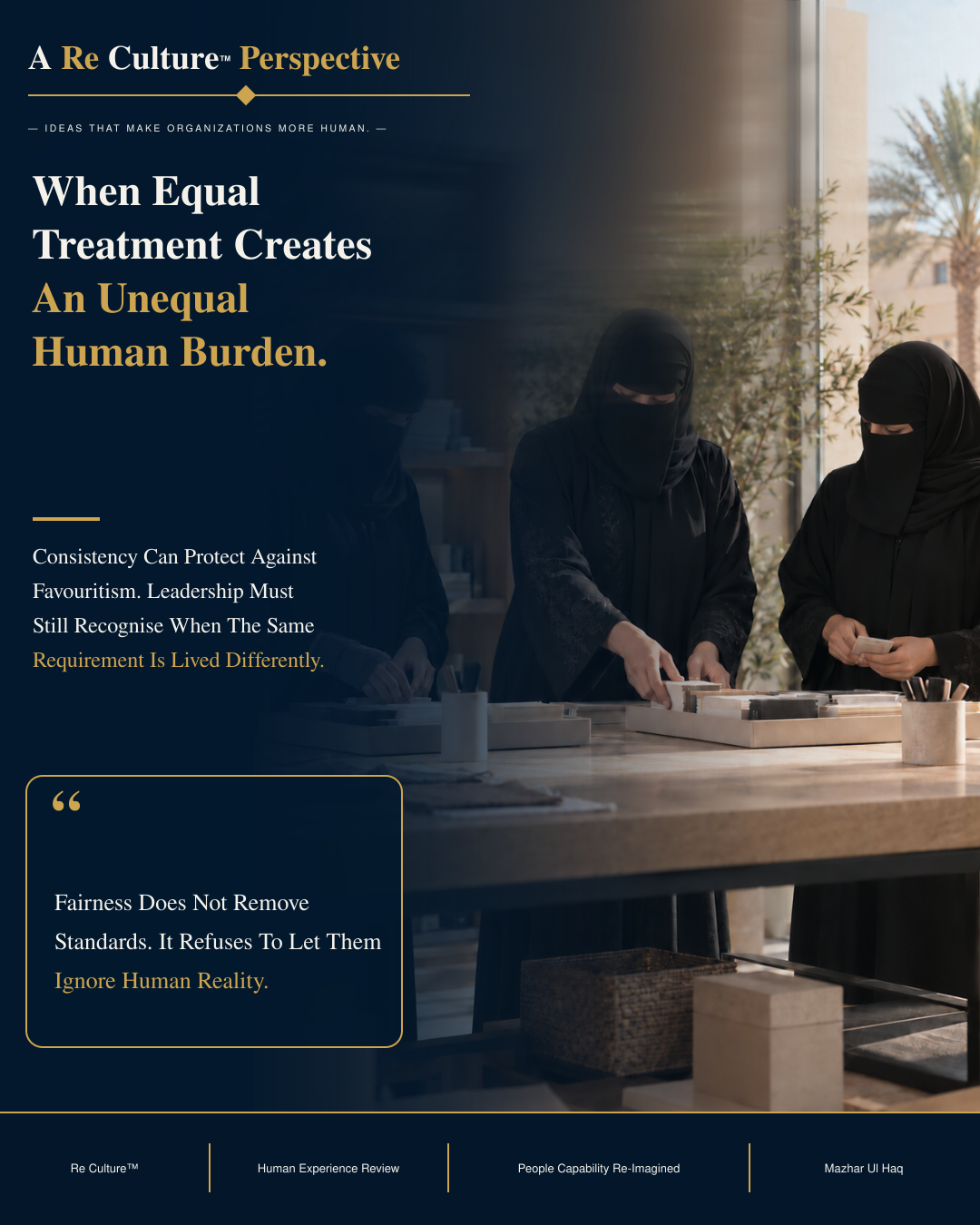
Consistency Promises Fairness. The Same Rule, Deadline, Process Or Expectation Can Protect People Against Preference, Favouritism And Arbitrary Treatment. Institutions Need Standards That Do Not Change According To Status, Proximity Or Personal Influence.
But Sameness Can Quietly Become A Substitute For Judgement. A Rule May Be Applied Identically While The Human Burden It Creates Is Not Identical At All.
Two People Can Receive The Same Requirement And Carry Very Different Costs. One May Be Living With Illness Or Physical Limitation. Another May Be Completing Unfinished Work Left By Others, Entering An Unfamiliar Role, Or Working With Unequal Access To Time, Tools, Information And Support.
These Differences Are Not Always Visible. A Person May Remain Composed, Capable And Professional Until The Unequal Burden Appears Only As Delay, Fatigue, Reduced Output Or A Request For Flexibility. By Then, The Experience May Be Read As Performance Rather Than Context.
The Sentence, ‘The Rule Is The Same For Everyone,’ Can Protect Neutrality. It Can Also End Listening Before Leadership Has Examined Whether The Rule Is Being Lived In Meaningfully Different Conditions.
Fairness Does Not Require Leadership To Abandon Standards. It Requires Leadership To Distinguish What Must Remain Common From What Can Responsibly Change So That The Standard Does Not Impose A Disproportionate Human Cost.
The Route May Become More Humane Without Removing Responsibility. Timing May Change. Tools, Access Or Instructions May Improve. A Handover May Be Completed. Work May Be Redistributed Temporarily. The Standard Can Remain While The Institution Stops Pretending That Every Person Reaches It From The Same Place.
Data And Systems Can Show Whether A Rule Was Applied. They Cannot Alone Decide Whether Its Human Effect Is Fair. AI May Extend Capacity; It Must Never Replace Human Judgement. Fairness Requires Context, Proportionality, Listening And Answerability.
Leadership Before Authority Holds The Standard And The Person Together. A More Human Institution Does Not Confuse Fairness With Sameness. It Protects Consistency From Becoming An Escape From Discernment.
What Must Remain Common, What Human Difference Is Meaningful, And Who Is Carrying More Under A Rule That Appears Equal?