
A Process Can Be Ready To Close Before The Person Who Will Carry Its Consequence Has Been Fully Heard. As Completion Approaches, What Still Needs To Be Understood Can Become Secondary. The Person May Not Be Resisting The Decision Or Avoiding Responsibility. They May Be Explaining An Unrecorded Responsibility, An Earlier Instruction That Changed What Was Possible, A Constraint That Can't Be Reduced To One Sentence, Or A Human Consequence That Will Become Visible Only After The Process Has Closed.
Urgency Changes How Listening Happens. An Explanation Can Sound Like Delay, And A Question Like Disruption. Someone Asking For A Few More Minutes Can Be Treated As Preventing The Institution From Moving Forward. This Is Where Leadership Must Notice More Than The Pace Of The Process.
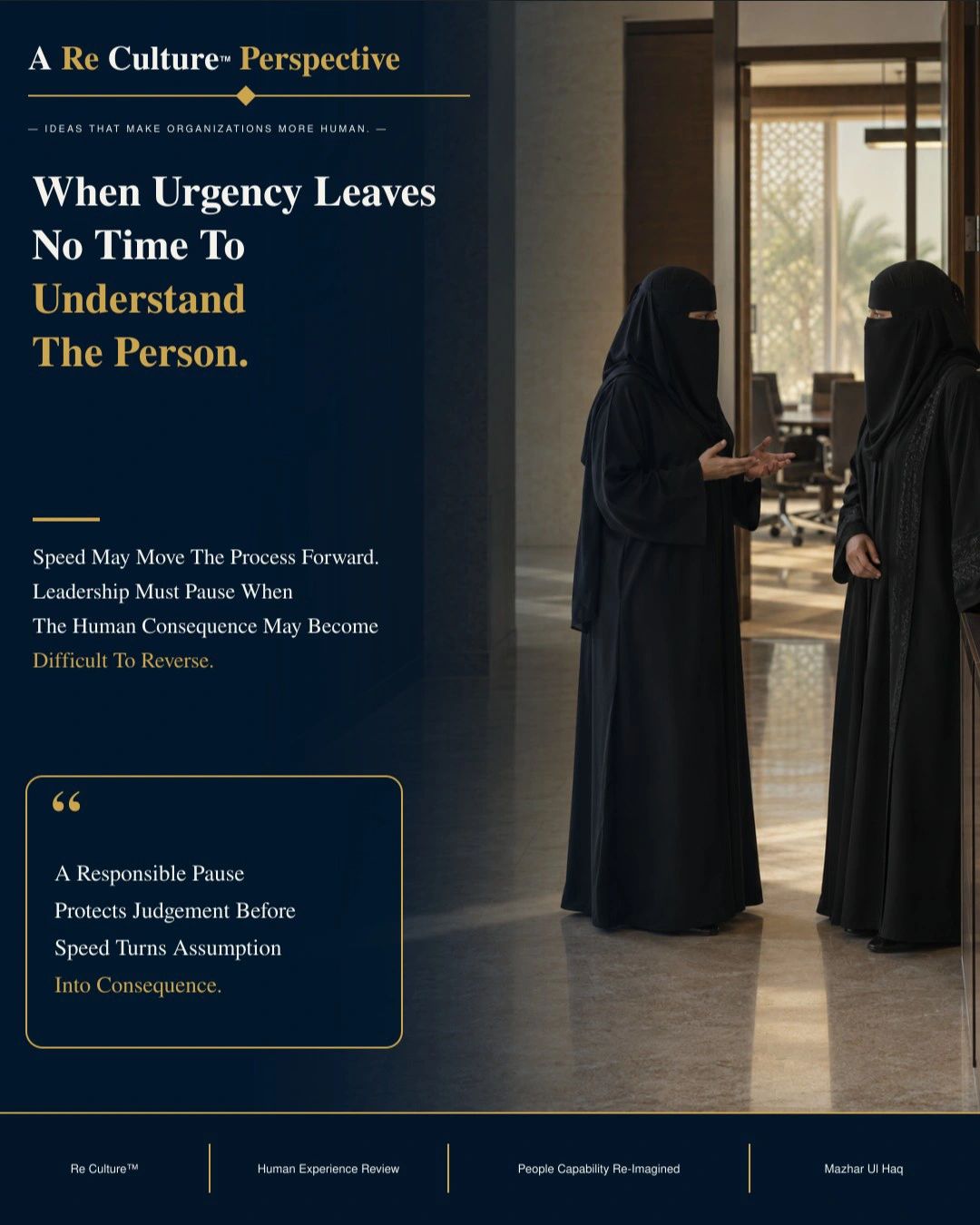
The Senior Leader In This Visual Is Moving Towards Her Next Responsibility. Yet She Stops, Turns Fully Towards Her Colleague And Gives Her Attention To What Has Not Been Heard. It Is A Deliberate Refusal To Let Forward Movement Become More Important Than Human Understanding. That Pause Matters Because There Is A Human Difference Between Being Heard Before A Decision And Being Invited To Explain Its Damage Afterwards.
Before The Decision, Listening Can Still Inform Judgement, Assumptions Can Be Examined And Missing Context Can Be Recognized. The Person Can Remain Present Within The Decision That Will Affect Them. Afterwards, The Consequence May Already Be Administratively Complete. Their Explanation May Be Received, But The Institution’s Possibility Of Responding May Have Narrowed.
What Could Have Informed Judgement Can Then Become A Reaction To Its Outcome. A Responsible Pause Doesn't Avoid Difficult Decisions Or Remove Standards. It Ensures That A Decision Is Not Mistaken For Complete Simply Because Its Procedure Has Been Completed. Leadership Before Authority Becomes Visible At This Exact Point.
Authority May Have Everything Required To Proceed. Leadership Must Still Ask Whether Something Human Remains Unheard, Whether An Assumption Is Being Treated As Fact, And Who Will Carry The Consequence If The Institution Moves Too Quickly. The Difference May Be A Few Minutes Of Undivided Attention, One Further Conversation, Or The Willingness To Delay Closure Until The Person’s Reality Has Been Understood With Enough Care For Leadership To Remain Answerable For What Follows.
A More Human Institution Does Not Confuse Urgency With Completeness. Speed May Move A Process Forward, But It Cannot Inherit Responsibility For What The Decision Will Ask A Human Being To Carry. The Responsible Pause Is Not The Absence Of Leadership. It Is The Moment Leadership Refuses To Let A Process Become Final Before Human Judgement Is Ready.
What Still Needs To Be Heard Before This Decision Becomes Final, And Who Will Carry The Consequence If Leadership Moves Too Quickly?